The oldest books in many Balinese family compounds aren’t made of paper. They’re bundles of dried palm leaf, each strip a few centimeters wide, threaded on a cord between two wooden covers and kept wrapped in cloth, often in a shrine or pavilion of the house temple. Some hold prayers. Some hold medicine. Some hold the family’s own history.
These are lontar, and Bali is one of the few places where people still write them by hand. Here’s how they’re made, what’s inside, and where you can try writing one yourself.
What a lontar is
Lontar is both the manuscript and the tree. The leaves come from the palmyra palm, which does well in Bali’s drier north and east; the name is usually traced to the Old Javanese ron tal, leaf of the tal palm. Preparing leaves for writing is slow. They’re cut, dried, soaked or boiled, dried again, pressed flat, trimmed to size and pierced so they can be strung together. A finished book is a stack of these strips held between two wooden boards. For centuries lontar were the main way of writing things down in Bali, and many families, temples and priestly households still keep collections.
How the letters appear
There’s no pen and, at first, no ink. The scribe incises the letters into the surface of the leaf with a pengrupak, a small knife with an angled blade, holding the leaf steady on the lap or a low stand. At that stage the writing is nearly invisible, just faint scratches. Then the leaf is rubbed with soot, traditionally from burnt candlenut mixed with a little oil, and wiped clean. The black stays in the grooves and the letters appear.
Two things follow. Mistakes can’t be erased, so experienced scribes plan each line before they cut. And lontar need looking after: humidity, insects and time all work against them, which is why old texts have long been copied onto fresh leaves.
What’s written inside
Almost everything a society needs to remember:
- Religion and philosophy: teachings, prayers and guidance for priests.
- Medicine: the usada texts, which describe illnesses, plants and treatments, and are still consulted by traditional healers. Our piece on Balinese traditional healers goes further.
- Calendars: the wariga, used to find good and bad days for ceremonies, building and farming.
- Literature: poems and stories, including Balinese versions of the Ramayana and Mahabharata.
- History and law: family and royal chronicles called babad, and awig-awig, the written rules of a village.
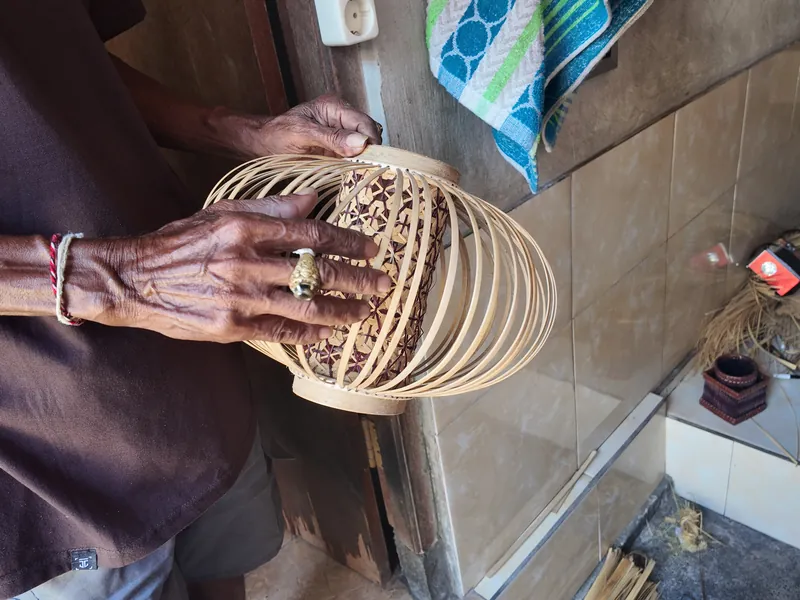
Some lontar are illustrated. Known as prasi, they carry finely incised drawings in place of, or alongside, text, like the one being held up in the photo at the top of this page.
Aksara Bali in a few minutes
The script used in lontar is aksara Bali, a relative of the old scripts of India and Java. Each basic letter is a consonant with a built-in “a” sound, and small marks above, below or beside it change the vowel. The traditional order of the eighteen basic letters begins ha, na, ca, ra, ka, and Balinese children still learn it at school. Traditional texts run their words together without spaces, so reading an old lontar takes practice even for people who know every letter. Once you know what it looks like you’ll spot it everywhere, from temple names to the second line on street signs.
The script even has its own holy day. Saraswati, the day of knowledge, comes round every 210 days; books and lontar receive offerings, and many Balinese avoid reading or writing. The next one falls on Saturday 31 October 2026.
A class with Pak Nyoman Widana in Kerambitan
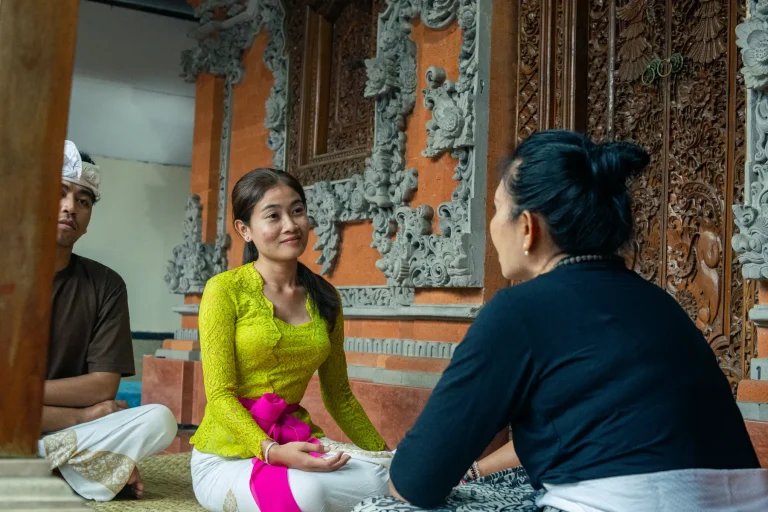
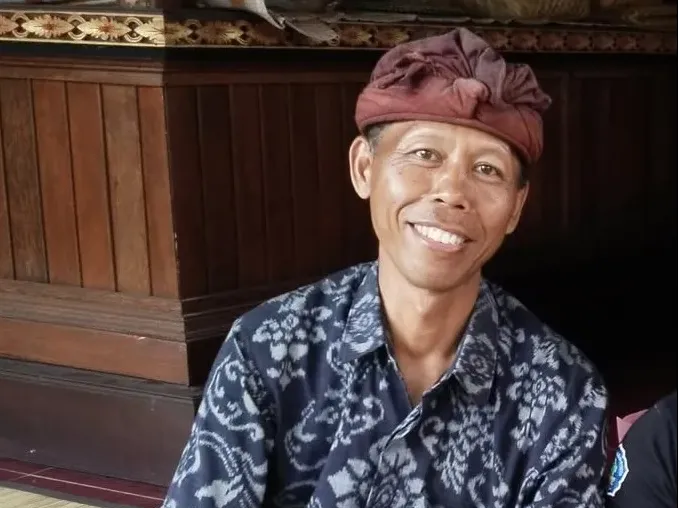
Pak Nyoman Widana keeps the lontar tradition going by teaching people to write and translate palm-leaf manuscripts. He shares knowledge rooted in philosophy, spirituality and storytelling, and much of his work is aimed at younger Balinese, so that traditional literacy doesn’t fade with his generation.
The Ancient Bali Manuscripts Class takes place in Kerambitan village, about 20 minutes from Tabanan town, and runs three to four hours:
- A traditional Balinese blessing to begin, for positive energy and protection.
- An introduction to the philosophy and cultural meaning of lontar.
- Basic Balinese script, written together with Pak Nyoman.
- Hands-on practice with traditional lontar writing and carving.
- Making your own personalized lontar, wrapped in tridatu thread, to take home.
Tridatu is the red, white and black thread many Balinese Hindus wear or tie for protection; the colors stand for Brahma, Shiva and Vishnu. The class is semi-indoor, runs by arrangement and takes groups of 2 to 25. Bring reading glasses if you use them: the letters are small and the knife work is fiddly. Expect your first letters to look wobbly. The blade tends to follow the grain of the leaf, and finding the right pressure takes a while, which is exactly why a patient teacher helps.

Where the palm grows: Tejakula
To see the tree itself, head for the dry north-east coast. On the Tejakula journey, your host in the fishing village of Les shows you the lontar palms and how they’re tapped for arak, the local spirit, alongside the salt-making Les is known for. The same tree gives Bali both its books and a drink. Day two brings a morning snorkel off Les and a meal in a traditional wood-fired kitchen. Our story on Bali’s sea salt farmers covers the salt side of the same day.
Handling old manuscripts
- Don’t touch a manuscript unless the owner offers it to you. Some are sacred and are opened only by certain people, or on certain days.
- If you’re handed one, have clean, dry hands with no lotion, keep the leaves flat and supported, and don’t bend them.
- Never set a manuscript on the floor or step over one. Lontar are treated with the respect due to sacred objects.
- No flash, and ask before any photo.
- In Singaraja, the Gedong Kirtya library, founded in 1928, holds a large collection of lontar. Check opening hours before you go.
A lontar class is slow, careful and quietly absorbing, and you leave with a souvenir that’s hard to beat: a few lines of your own on a palm leaf, tied in tridatu. For the beliefs behind the script, our guide to Balinese culture and traditions is a good next read.