On the Tuesday before Galungan, a lot of Balinese villages are up before the roosters. Men sit on their heels in the family courtyard chopping pork, grating coconut and pounding spice paste for lawar, the minced dish at the center of the holiday meal. By afternoon the tall bamboo poles go up along the road, one in front of almost every gate, and the whole island starts to look dressed for something.
That something is Galungan, one of the most important festivals in the Balinese Hindu calendar. In 2026 it falls on Wednesday 17 June, and Kuningan, which closes the festival period, follows ten days later on Saturday 27 June. If you’re in Bali that fortnight, here is what you’ll see, what changes for visitors, and how to take part without getting in the way.
The dates: 17 and 27 June 2026
Galungan doesn’t follow the Western calendar or the lunar one. It runs on the pawukon, a 210-day cycle, so it comes round about every seven months and some years get two. 2026 gets one: the previous Galungan was on 19 November 2025, and the next falls on 13 January 2027.
The two main days are only part of it. The run-up and the tail end have names of their own:
- Sunday 14 June, Penyekeban: bananas and other fruit are covered up so they ripen in time for the offerings.
- Monday 15 June, Penyajaan: traditionally the day for making jaja, the colored rice cakes that end up stacked in offering towers.
- Tuesday 16 June, Penampahan: the slaughter day. Pigs are killed for lawar, sate and other dishes, and the penjor go up in the afternoon.
- Wednesday 17 June, Galungan: families pray at the house temple, then at village temples, dressed in their best.
- Thursday 18 June, Manis Galungan: a day for visiting relatives and going out. Popular parks and beaches fill with Balinese families.
- Saturday 27 June, Kuningan: the closing day, with its own offerings and prayers in the morning.
What Galungan celebrates
The short version: the victory of dharma, the right order of things, over adharma, its opposite. Galungan is also a homecoming. Balinese families believe the spirits of their ancestors come back to visit the family compound during these ten days, and much of the food, the offerings and the decoration is there to welcome them.
Kuningan sends them off again. The name comes from kuning, yellow, after the turmeric-colored rice in the day’s offerings. You’ll also see tamiang, round discs woven from young coconut leaf that look like small shields, hanging at shrines and gates. Prayers on Kuningan are usually finished by around midday, because the ancestors are believed to leave by then, so go in the morning if you want to watch.
What you’ll notice as a visitor
Penjor on every road
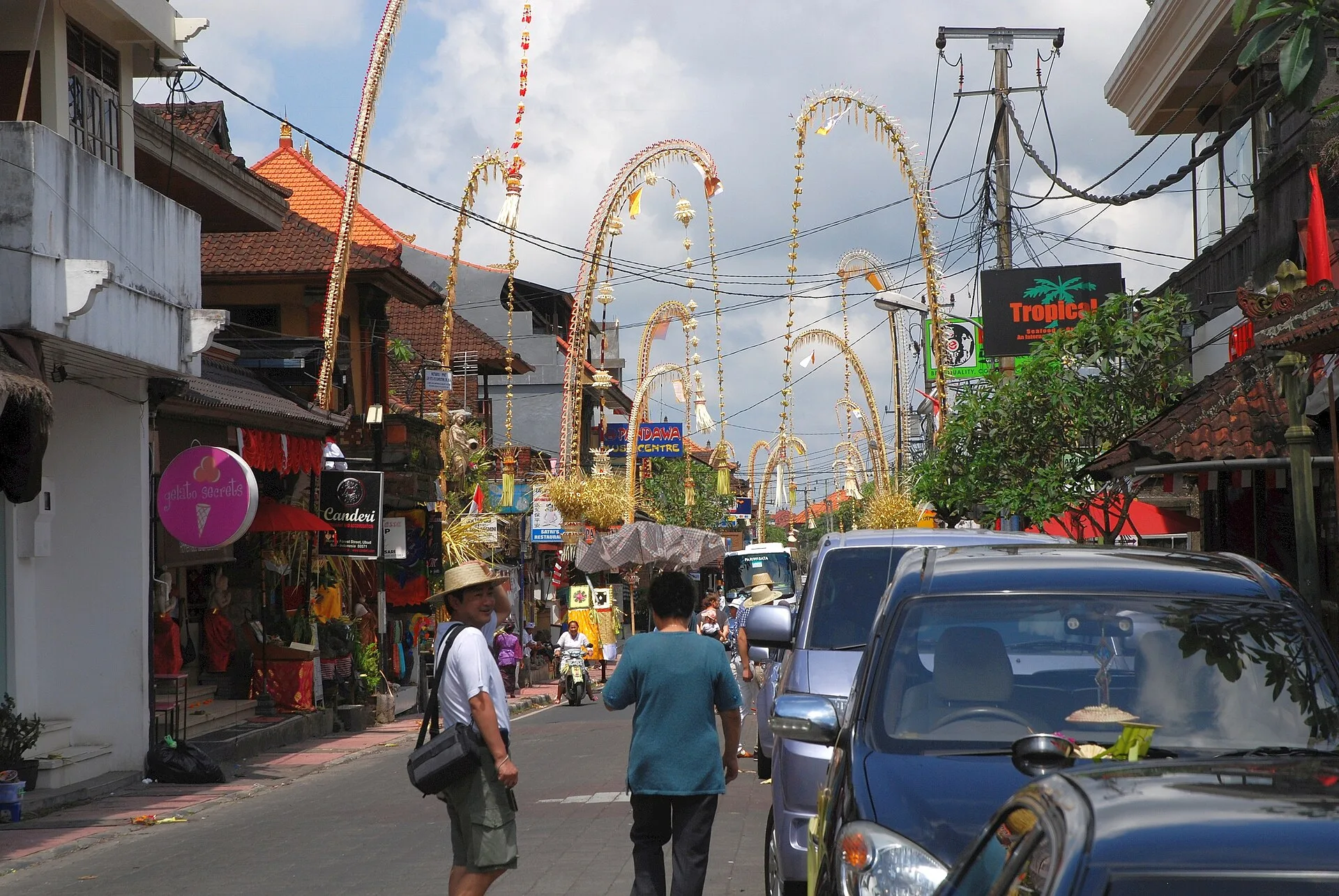
A penjor is a long bamboo pole bent over at the top, so the tip hangs above the road, and dressed with woven young coconut leaf, rice stalks, fruit, cakes and cloth. A small offering shelf is tied near the base. People often explain the shape as a mountain, and the decorations as thanks for what the land provides. Each household makes or buys its own, so a village street becomes a long, swaying arcade. Many stay up for about a month.
Temple clothes and slower roads
Expect families on motorbikes in white and gold temple dress, a tower of fruit and cakes balanced on someone’s lap. Many Balinese who work in the south go home to their villages for the holiday, so Denpasar can feel quieter while roads into the countryside get slower. A temple procession sometimes closes a stretch of road for a while; there’s nothing to do but wait.
Shorter hours, fewer staff
Some warungs, shops and family-run businesses close for a day or two around Galungan, and hotels and restaurants may run with fewer staff. The main tourist areas keep working more or less as normal. If you rely on a particular driver, book early and expect them to take Galungan day off.

Where to see it: Penglipuran, Ubud and Bedulu
Any village road will do, but some places make the most of it. Penglipuran in Bangli is the famous one. Its family compounds line a single sloping street behind near-identical gateways, and at Galungan each one puts up a penjor, so you get a corridor of matching poles running uphill toward the temple. It’s no secret, and plenty of Indonesian visitors come for the same photo, so arrive early. Our guide to Penglipuran and Bangli covers how to visit well.
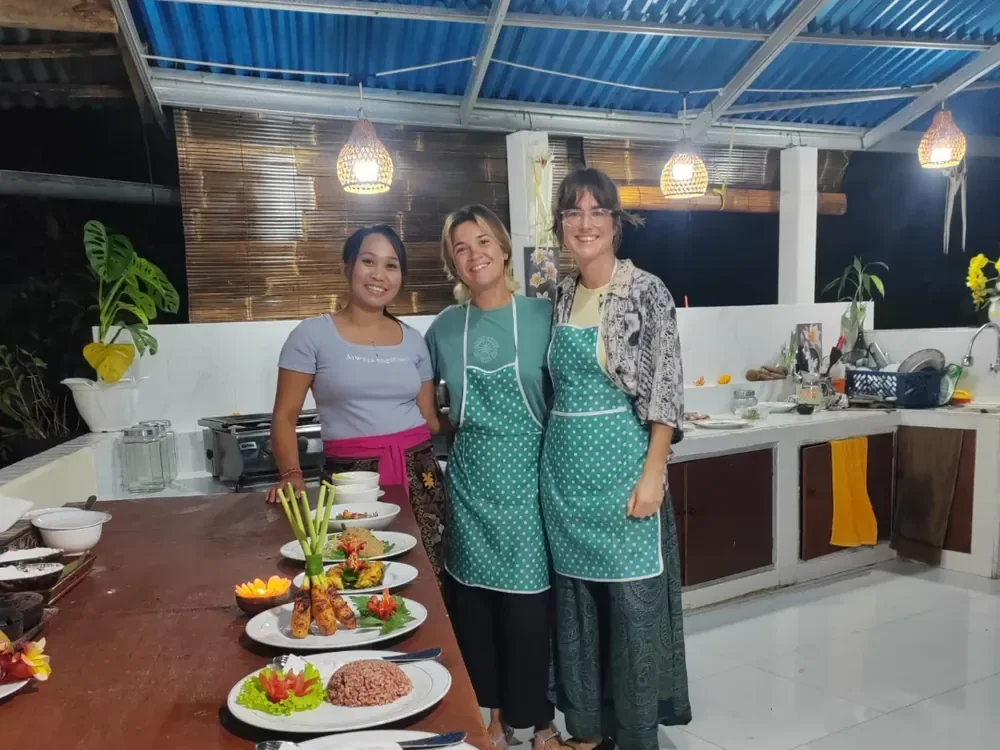
The Bangli two-day journey starts in Penglipuran and its bamboo forest, adds a cooking class where you make base genep and sate lilit, and ends the next morning with melukat, a water purification at Pancoran Alas Tapa guided by the local priest. Springs and temples are busy in Galungan week, so check the timing with your guide.
Ubud dresses up too; its main streets turn into the arcade of penjor you see in the photo at the top of this page. The Ubud journey begins at Puri Peliatan, where you dress in Balinese attire and make canang before a palace tour, and has an evening dance performance on day one.
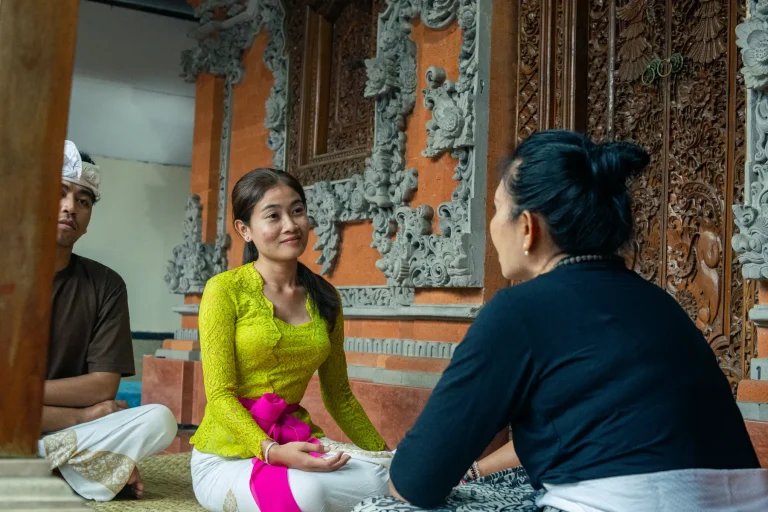
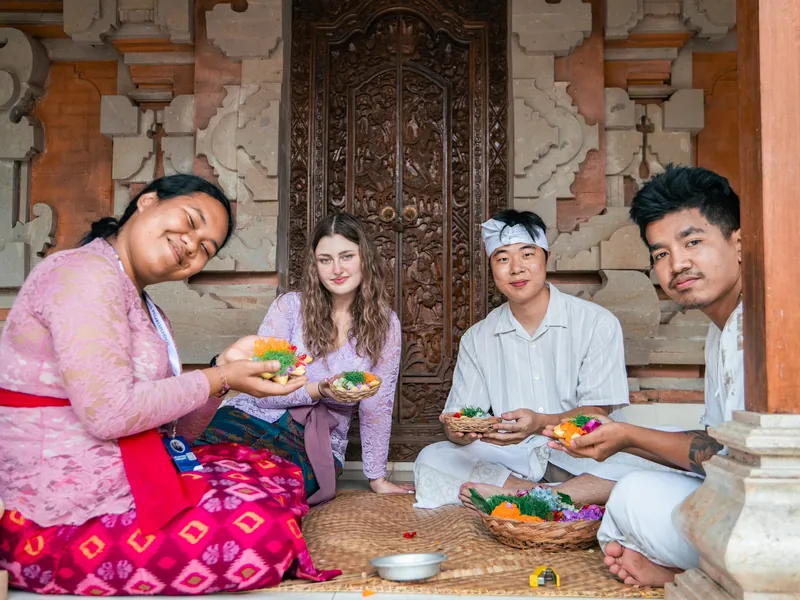
Fifteen minutes from Ubud, Bedulu is where most of our Curated Tours run, including these two. The Living Heritage Village Walking Tour takes you through temples, family compounds and the workings of the banjar, the neighborhood council that organizes village life. The Offerings of Bali session is the hands-on one: you make canang sari and a gebogan fruit tower, dress in ceremonial clothes, join a family temple blessing with holy water and bija (grains of rice pressed to the forehead), then share the offering meal, called ngelungsur.
Etiquette for Galungan week
Balinese families are generous with visitors during festivals. A few habits help keep it that way:
- Wear a sarong and sash at any temple, even if you’re only standing at the edge. Cover your shoulders.
- Don’t walk in front of people who are praying, and don’t climb on walls or shrines for a better angle.
- Watch your feet. There are offerings on the ground everywhere this week, and stepping on one is the classic visitor mistake.
- Ask before you photograph someone praying. No flash, and no drones over temples.
- If a family offers you food or a drink, accept a little. Eat, give and receive with your right hand.
- Balinese custom asks women who are menstruating not to enter temples, and visitors are expected to follow the same rule.
If you want to know what’s in those small palm-leaf trays before you go, read our piece on how canang sari are made.
Questions travelers ask
Is Galungan a good time to visit Bali?
For culture, yes: it’s the week when the island looks and sounds most like itself. Plan around it, though. Book drivers and tours ahead, expect slower roads on the main days, and don’t count on every small restaurant being open. Beaches, hotels and the big tourist areas carry on much as usual.
Can visitors join the prayers?
Usually you watch from a respectful distance unless someone invites you in. Joining a family blessing as a guest is exactly what the Offerings of Bali session arranges, with a host family in Bedulu. It runs by arrangement for groups of 5 to 30 and takes two to three hours.
What happens on Kuningan, 27 June?
Families make offerings with yellow rice, hang tamiang at their shrines and pray again, mostly in the morning. It’s a calmer day than Galungan and a good one to see a village temple ceremony, as long as you’re dressed for it and keep a little distance.
Cover photo: Tigerente / Wikimedia Commons, CC BY-SA 4.0