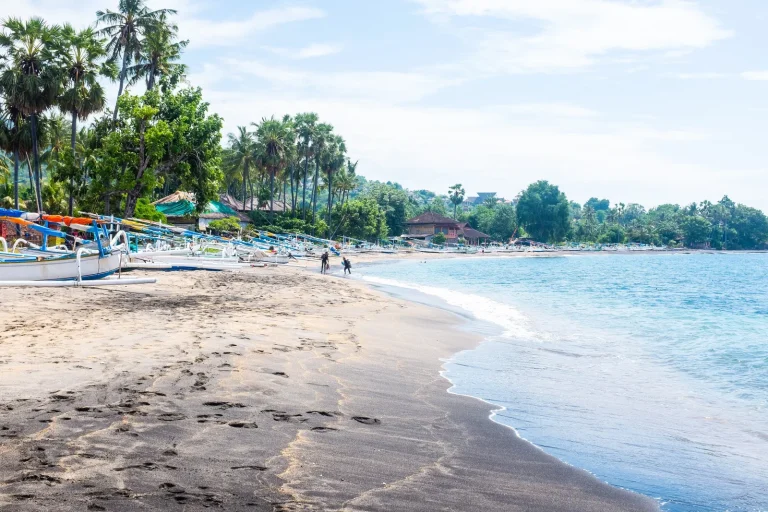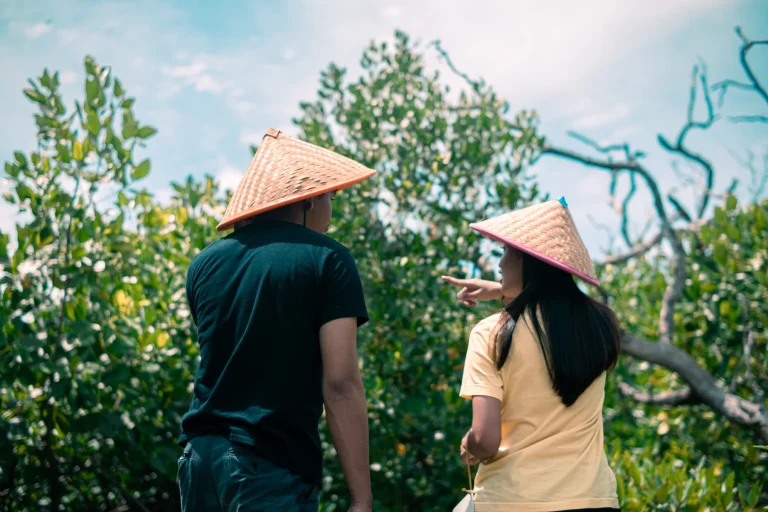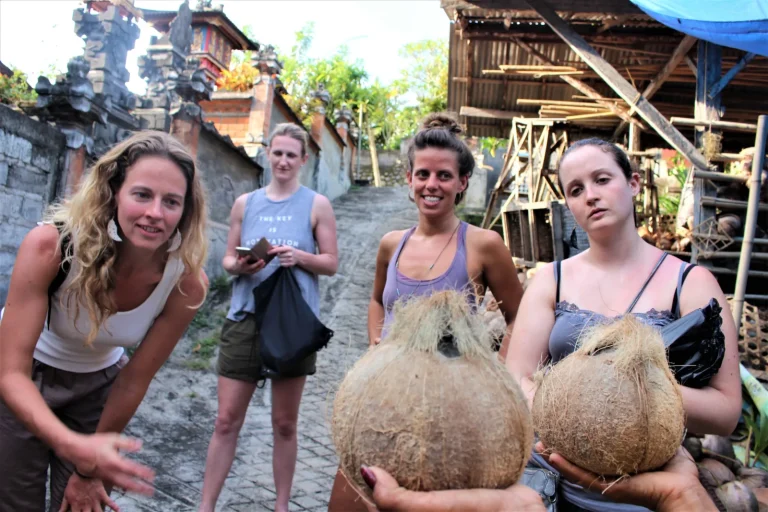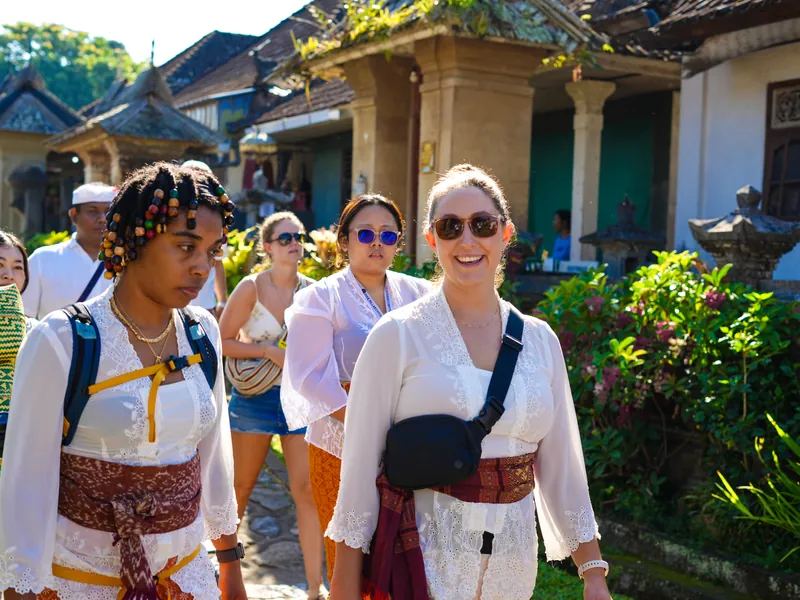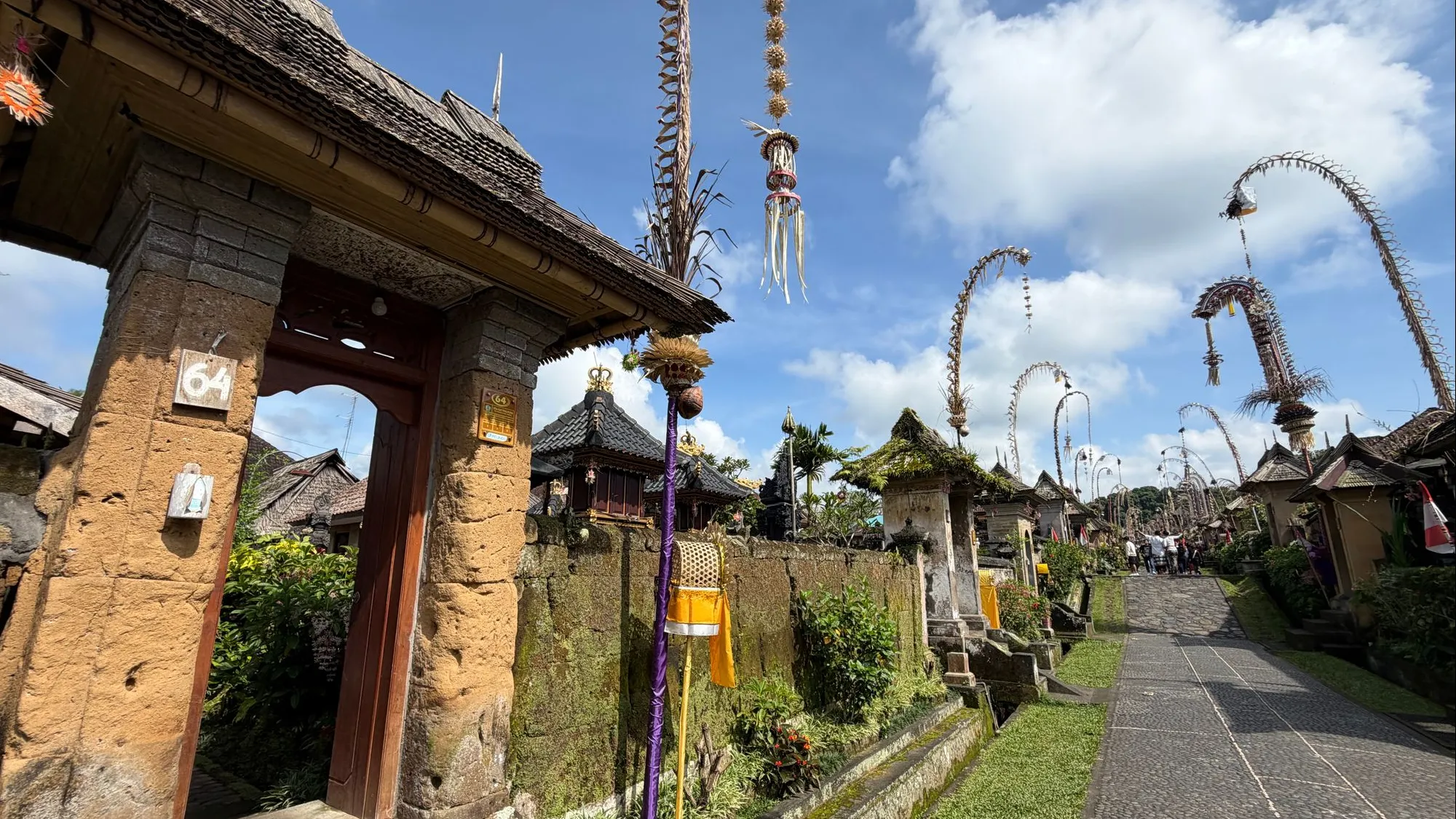
Penglipuran is built on a slope, and the slope is the point. A stone-paved street climbs through the middle of the village toward the main temple at the top. Family compounds line both sides behind gateways so alike they could have been cut from one pattern, and the lowest part of the village is traditionally set aside for the cemetery. The layout follows a Balinese idea of order that runs from the sacred uphill end, through the everyday middle, down to the impure lower end.
It’s also one of the most visited villages in Bali, and on a busy weekend it can feel as if there are more visitors than residents. But people live here, cook here and pray here. How you visit decides if you’re a guest or one more person standing in someone’s doorway.
How Penglipuran is laid out
The village sits in Bangli regency, north-east of Ubud on the road up toward Kintamani, and it’s noticeably cooler than the coast. Each compound opens onto the main street through an angkul-angkul, a narrow roofed gateway, many of them topped with split bamboo shingles. Behind each gate is a family’s whole world: a house temple, sleeping pavilions, a kitchen and a yard.
Motor vehicles stay off the main street; you park at the entrance and walk. The village is often described as one of the cleanest in Bali, and it looks it, with planted verges and very little litter.
It keeps some rules of its own, too. The best known is a ban on polygamy: a plot at the edge of the village, called karang memadu, is set aside for any man who takes a second wife, and he is expected to live there rather than in the village proper.
When to go
Early morning or late afternoon. Tour groups tend to arrive from mid-morning and leave after lunch, and weekends and Indonesian school holidays are the busiest times. At either end of the day the light is softer, the street is quieter, and families are more likely to have time to chat.
The most photographed time of all is around Galungan, when every compound puts up a penjor, the tall decorated bamboo pole, and the street turns into a corridor of matching arches. In 2026 Galungan fell on 17 June, Kuningan follows on 27 June, and many penjor stay up for weeks afterward. It’s lovely and it’s crowded; our Galungan and Kuningan guide explains what you’re looking at.
If you come early, bring long sleeves or a light layer: mornings up here can be fresh, and afternoon showers can roll in from the hills. There is an entrance ticket for visitors. Prices change, so check before you go. Our Bangli journey includes all activity fees.

Being a guest in a living village
Penglipuran welcomes visitors, and many families earn part of their living from them. The arrangement works best when visitors behave like guests:
- Ask before you step through a gate. Some families invite visitors in, often to sell drinks, snacks or crafts. A compound without an invitation is a private home.
- Buy from households. Penglipuran is known for loloh cemcem, a tangy herbal drink made from the leaves of the cemcem tree and sold from family compounds. A bottle bought at the gate puts money straight into a household.
- Keep kitchens and bedrooms off your camera unless you’re invited to photograph them.
- Dress for the temple if you plan to go into the village temple at the top: sarong and sash. The street itself only needs modest clothes.
- Keep your voice down near shrines, and don’t sit or stand on shrine platforms or walls.
- Step aside for offerings and processions. If a family is carrying offerings along the street, give them the middle of the path.
- Leave the drone in the bag, and take your rubbish out with you.
The same thinking applies to buying anything in Bali. Our guide to ethical shopping in Ubud covers how to tell who actually benefits from a sale.
The bamboo forest behind the village
Walk up past the last compounds and the houses give way to a bamboo forest that the village protects under its own customary rules. It’s often put at around 45 hectares, and it serves as a water catchment, a supply of building material and a green buffer around the settlement. Bamboo goes into roofs, fences and ceremonial objects here, which is one reason the village guards the forest so closely.
The path is shaded, quiet and cooler than the street. It can be muddy after rain and the mosquitoes like it, so wear proper shoes and bring repellent.
Going deeper: Bangli over two days
Penglipuran is a short stop on most itineraries. The Bangli journey builds a slow two days around it. Day one starts in Penglipuran and the bamboo forest, with a local lunch, then after check-in you join a cooking class to make base genep and sate lilit, the spice paste and minced satay at the heart of Balinese cooking (our base genep guide has a recipe). Day two is about water: a walk through rice fields to Tangkup Waterfall, then melukat, a purification at Pancoran Alas Tapa guided by the local priest. It helps to read up on what happens at a melukat beforehand. Hotel pickup is from Ubud, Sanur, Seminyak, Canggu, Nusa Dua or Denpasar.
If you’re based in Ubud with only half a day, the Living Heritage Village Walking Tour in Bedulu, 15 minutes away, covers similar ground on a smaller scale: temples, family compounds explained from the inside, the role of the banjar adat in village decisions, craft demonstrations and a visit to Puri Agung Bedulu. It runs by arrangement for groups of 5 to 30.
Questions travelers ask
How long do I need in Penglipuran?
An hour or two covers the street, the temple from outside and a walk into the bamboo forest. Allow longer if you stop to talk with families, which is the best part.
How far is it from Ubud?
Usually around an hour by car, depending on traffic. It combines easily with other stops in Bangli or with the drive up to Kintamani.
Is it still worth going if it’s so popular?
Yes, if you go early or late and treat it as a village rather than a film set. It’s one of the clearest places on the island to see how a Balinese community arranges its space around what it believes.