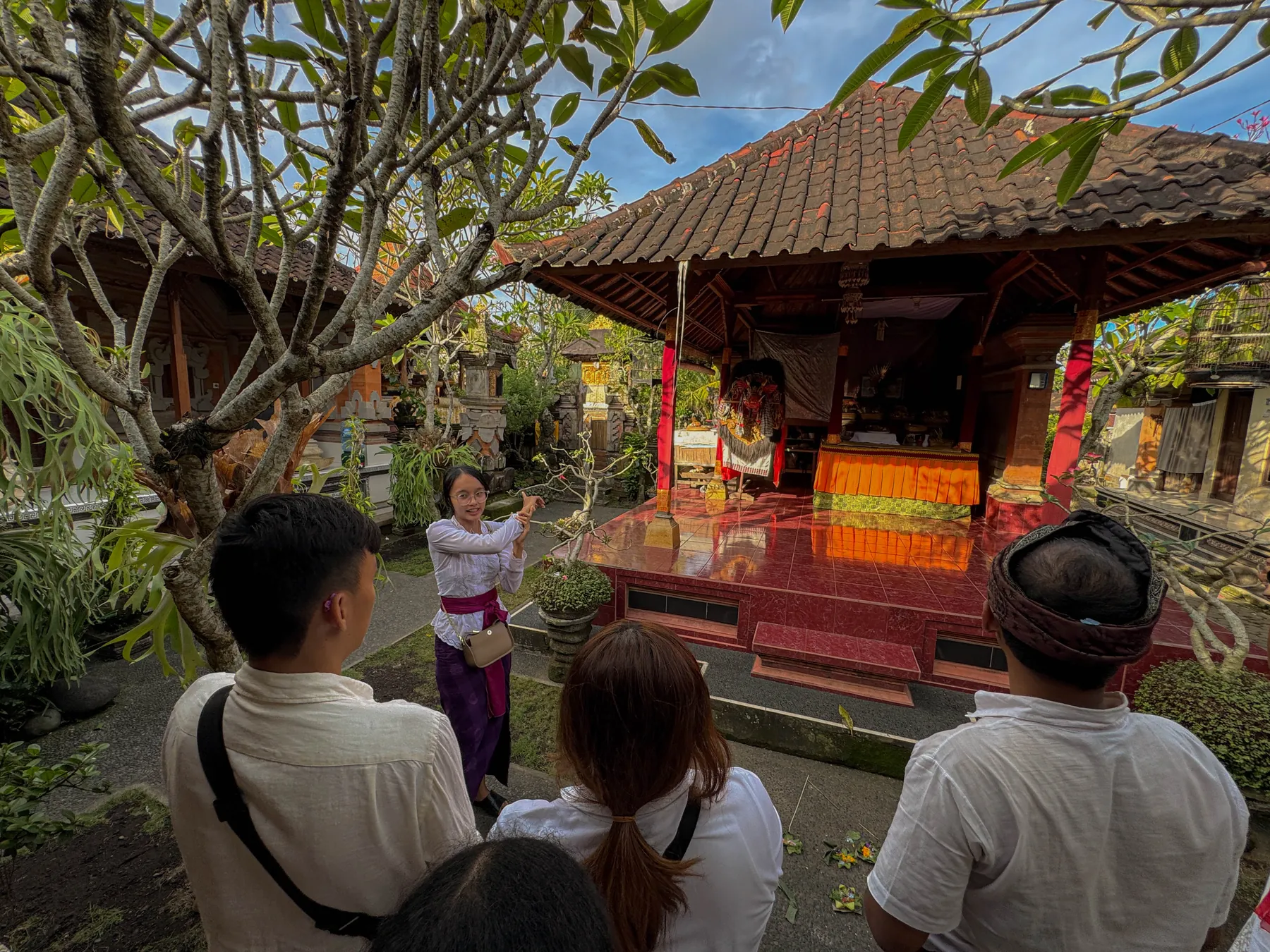
Walk into almost any Balinese family compound and look for the temple first. It won’t take long. In the south of the island it’s usually in the north-east corner, the one closest to the mountain and the sunrise: a cluster of small shrines, walled off from the kitchen and the sleeping pavilions. The pigsty and the rubbish heap, if there are any, sit at the opposite end, toward the sea.
That layout is a philosophy turned into architecture. The Balinese call it Tri Hita Karana, usually translated as the three causes of wellbeing, and you’ll hear it quoted by priests, farmers, hotel managers and government banners alike. Here’s what it means, where to see it, and where the ideal and the reality don’t quite line up.
The three harmonies, in plain terms
Tri Hita Karana holds that a good life comes from keeping three relationships in balance:
- Parahyangan: between people and God, or the divine.
- Pawongan: between people and other people.
- Palemahan: between people and the natural world.
None of this stays abstract for long. Each harmony has places, habits and institutions that go with it, and once you know what to look for you’ll see all three on an ordinary morning drive. For the wider picture of Balinese religion and custom, our deep dive into Balinese culture and traditions is a good companion to this piece.
Parahyangan: temples at every scale
The family temple in the corner of the compound is the smallest unit. Every village has its own set of temples too, usually three: Pura Puseh for the village’s origins, Pura Desa for the village itself, and Pura Dalem, connected with death and the cremation ground. Above those are temples for irrigation societies, for markets, for lakes and mountains, all the way up to the great temples of the whole island.
What you’ll notice as a visitor is the daily upkeep: fresh offerings every morning, someone sweeping the shrines, a person walking home from prayer with a flower tucked behind one ear and grains of rice on the forehead. Harmony with God is mostly a matter of small, regular acts.
Pawongan: the banjar and ngayah
Every village is divided into banjar, neighborhood associations that every household belongs to. You can spot a banjar hall, the bale banjar, by its open pavilion and the wooden slit drum, the kulkul, hanging in a small tower nearby. The drum calls members to meetings, and to help when something goes wrong.
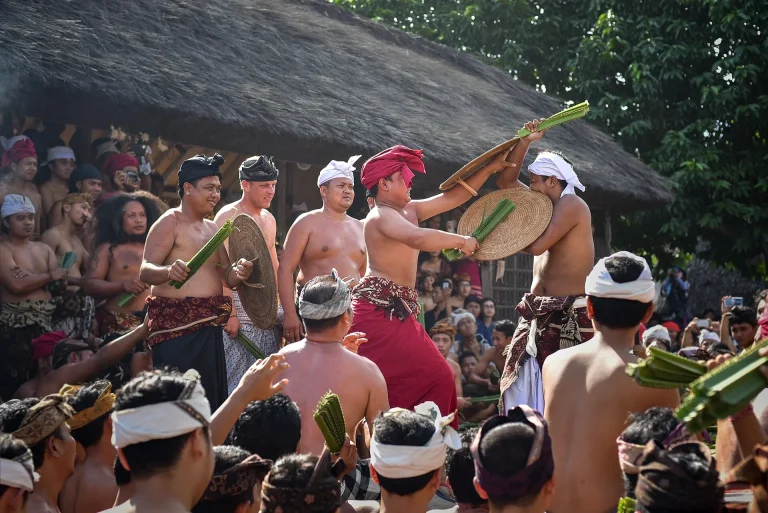
The banjar organizes cremations, weddings and temple festivals, and before Nyepi its young people build the giant ogoh-ogoh effigies that are paraded on the night before the day of silence. When something needs doing for the community, members turn up and do it, unpaid. That communal work is called ngayah, and it’s the backbone of pawongan.
For visitors, the practical upshot is that village life runs on obligations you can’t see from the road. When a driver or host has to leave early for a banjar meeting or a ceremony, the system is working as intended.
Palemahan: water, rice and the subak
The clearest example of harmony with nature is the subak, the cooperative system that shares irrigation water among rice farmers. Water runs from lakes and springs through a chain of canals and tunnels, each subak decides together when to flood, plant and harvest, and water temples at every level keep the arrangement sacred. Old inscriptions suggest the system has been running in some form for around a thousand years.
In 2012 UNESCO inscribed the subak landscape as a World Heritage site, under a title that names the philosophy directly: the Cultural Landscape of Bali Province, the Subak System as a Manifestation of the Tri Hita Karana Philosophy. The Jatiluwih terraces are part of it.
Smaller signs are everywhere. On Tumpek Wariga, which falls 25 days before Galungan, families tie offerings and cloth to fruit trees and ask for a good harvest. There’s a similar day for animals, Tumpek Kandang, when livestock get their own offerings.

Where the ideal meets reality
It would be dishonest to present Tri Hita Karana as a description of how Bali always works. Rice fields are being sold and built on, tourism competes with farmers for water, and plastic waste is a visible problem in many places. Plenty of Balinese invoke the philosophy precisely because it’s under pressure: as a standard to hold people to, including themselves.
This is also where visitors can help a little. Spend money in places that keep farmland farmed and villages lived in, stay on the paths between the paddies, and treat temples as places of worship rather than backdrops.
What to look for on your next drive
- A cluster of shrines in the upper corner of each family compound, on the side facing the mountain.
- A bale banjar beside the road, with its kulkul drum in a small tower.
- Little shrines standing in the middle of the rice fields, where farmers leave offerings for Dewi Sri, the rice goddess.
- Offerings and cloth tied around tree trunks, a sign that Tumpek Wariga has just passed.
Seeing it for yourself near Ubud
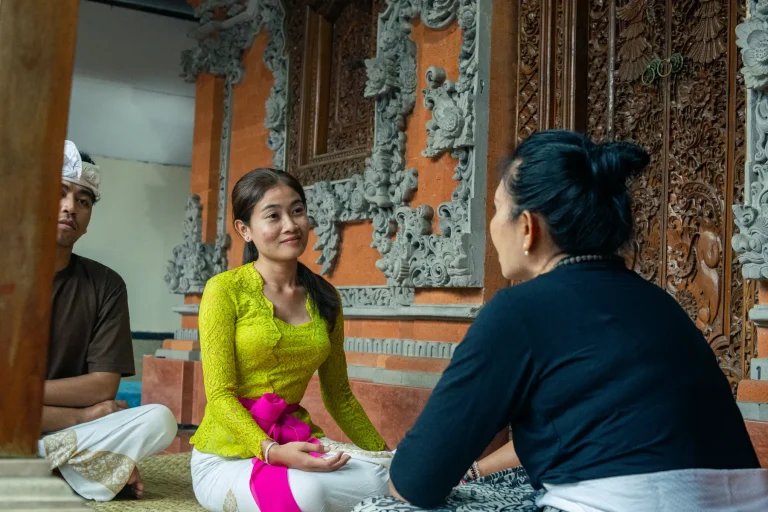
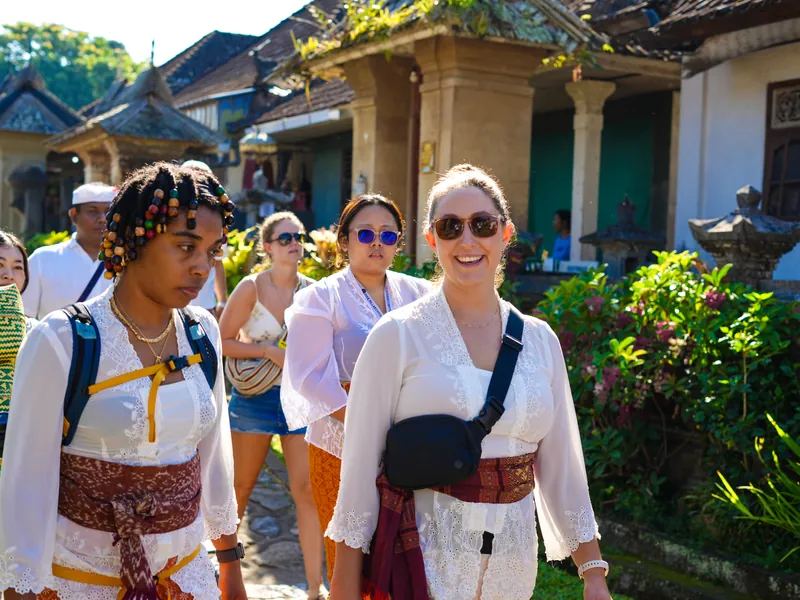
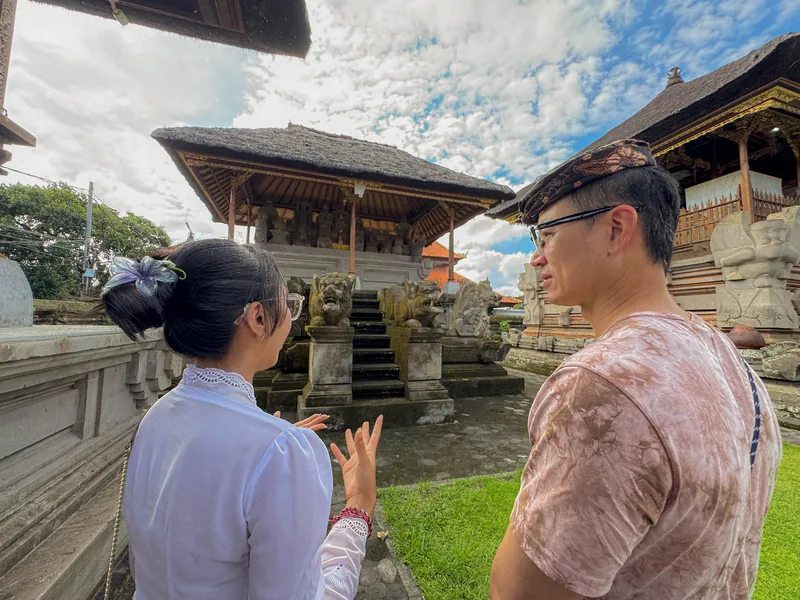
Discovering Bali’s Tri Hita Karana is a morning in Bedulu village, about 15 minutes from Ubud, that covers all three harmonies in one place. You walk through temples, homes and rice fields, learn about the banjar system and traditions like ngayah, see how subak and eco-friendly practices shape farming life, and take part in rituals along the way. It takes two to three hours and runs by arrangement for groups of five to 30.
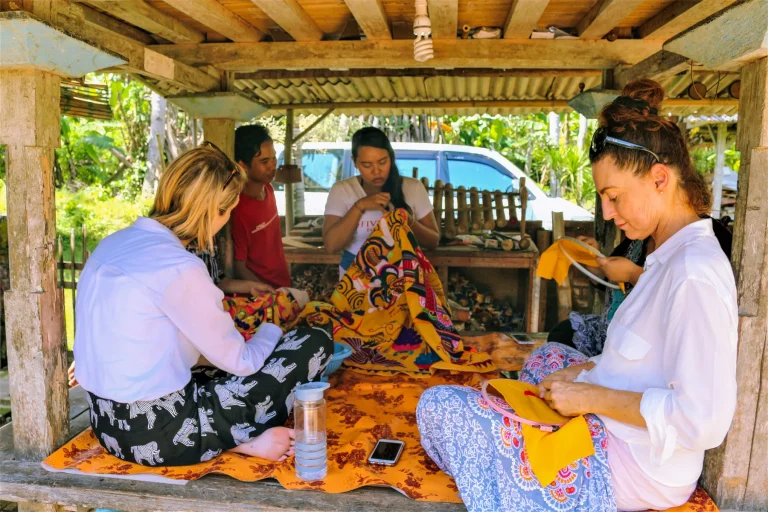
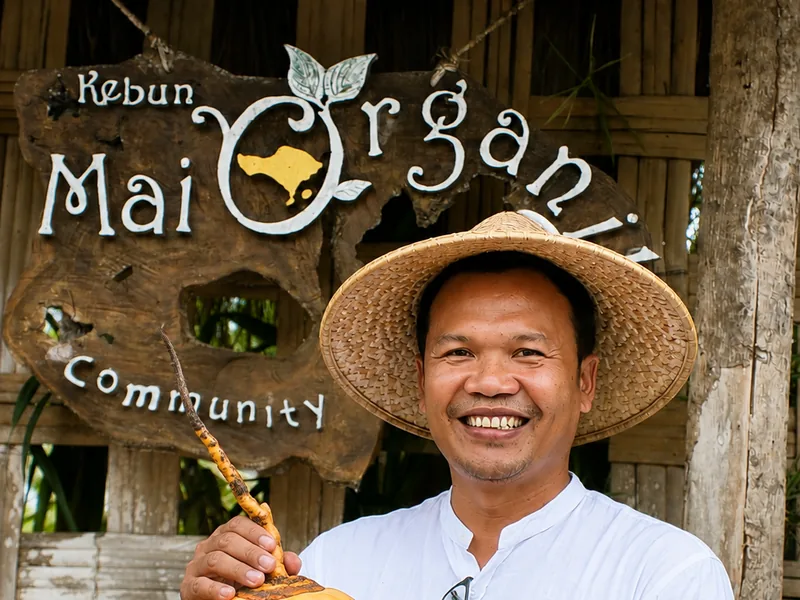
If the rice fields interest you most, From Subak Wisdom to Ancient Relief, also in Bedulu, goes deeper into palemahan: a walk through the paddies with a local farmer, how the water system works and what threatens it today, centuries-old carvings that tell stories of water, rice and ritual, and a visit to a traditional house.
To see subak at landscape scale, the Jatiluwih journey spends a night beside the UNESCO terraces and walks them with a local guide the next morning, explaining the irrigation system and the different types of Balinese rice. On the way there it visits an owl conservation project, where a farmer protects owls as natural pest control, which is palemahan in its most practical form. Our piece on how the subak still shares water goes further into the system.
Once you’ve seen the three harmonies you’ll keep noticing them: in the corner shrine, the drum tower, the canal running beside the road. Knowing what they are makes an ordinary drive across Bali far more interesting, and a morning in one village is the easiest place to start.