Bali celebrates Galungan twice in 2027. The first round falls on Wednesday 13 January, with Kuningan on Saturday 23 January. The second falls on Wednesday 11 August, with Kuningan on Saturday 21 August. Each time, the ten days in between are when Balinese Hindu families welcome their ancestors home.
This guide from Five Pillar Experiences covers what the days mean, what you’ll see, what closes, and how to take part politely.
Galungan 2027 dates, day by day
The festival runs on the pawukon, Bali’s 210-day cycle of named weeks, and Galungan is always the Wednesday called Buda Kliwon Dungulan. A cycle of 210 days is a little under seven months, so in some years Galungan happens twice, and 2027 is one of them. The June 2026 round is covered in our Galungan 2026 guide.
January 2027
- Sunday 10 and Monday 11 January, Penyekeban and Penyajaan: the first run-up days, which the Balinese calendar describes as days for self-restraint while the preparations begin.
- Tuesday 12 January, Penampahan Galungan: pigs are slaughtered for the festival food and offerings, and the penjor go up at the gates.
- Wednesday 13 January, Galungan: prayers at the family shrine, then at the village temples.
- Thursday 14 January, Manis Galungan: the day for visiting relatives and friends. In some villages, children dance a small barong from house to house, a custom called ngelawang.
- Saturday 23 January, Kuningan: the final day, with prayers held in the morning.
August 2027
- Sunday 8 and Monday 9 August: Penyekeban and Penyajaan.
- Tuesday 10 August: Penampahan Galungan, when the penjor go up.
- Wednesday 11 August: Galungan.
- Thursday 12 August: Manis Galungan.
- Saturday 21 August: Kuningan.
After that, the next Galungan falls on Wednesday 8 March 2028.
What Galungan and Kuningan are about
Galungan marks the triumph of dharma, truth and virtue, over adharma. Many Balinese describe it as a struggle that goes on inside each person, against anger, greed and ego, as much as in the world outside. It is also the time when the ancestors’ spirits are believed to return and visit their families, which is why so much cooking and offering-making goes on in the days before.
Kuningan, ten days later, is the farewell. Kuning means yellow, and the color runs through the day’s offerings, including yellow rice, as a sign of prosperity and gratitude. At family shrines you’ll see tamiang, flat round weavings of young palm leaf, and endongan, small woven pouches; both are understood as provisions for the ancestors’ journey back. The ceremonies wrap up by noon, so a Kuningan visit is a morning plan.
What you’ll notice around the island
Penjor at every gate
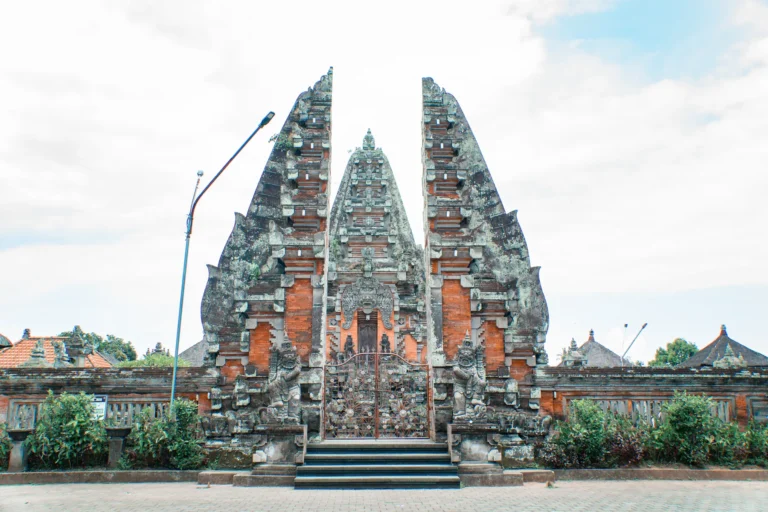
Penjor are curved bamboo poles decorated with janur (young coconut leaf) and the produce of the fields, set up at the gate of almost every Hindu home. They’re an offering of thanks for the land’s prosperity, and their shape is often read as a mountain, where the gods live. A village road lined with them is one of the great sights of the Balinese year. They traditionally stay up until Buda Kliwon Pegatwakan, five weeks after Galungan (17 February and 15 September 2027), when the natural decorations are burned and the bamboo is reused.
Processions and slower roads
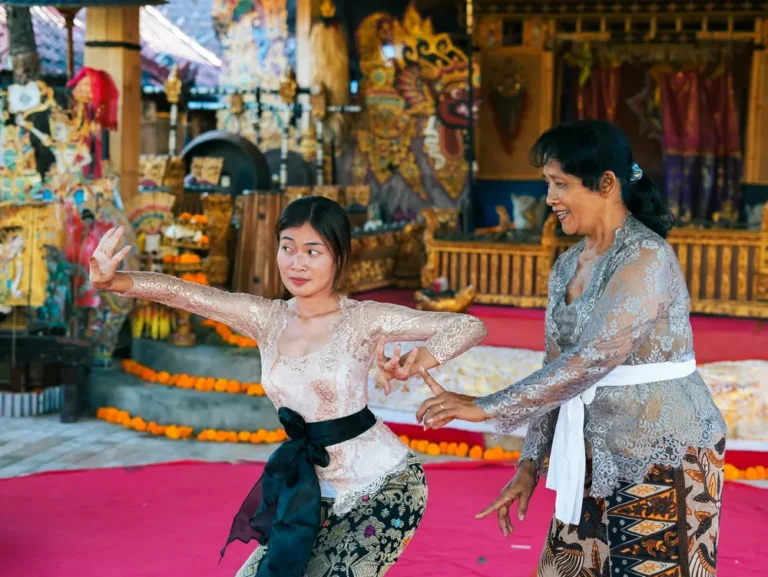
On Galungan morning, whole families ride to their temples in white and gold or brightly colored kebaya, with towers of fruit and cakes held on their laps. A procession may stop traffic for a few minutes; pull over and wait. Plenty of people who work in Denpasar and the resort towns head back to their home villages for the festival, so the city empties a little while the roads up into the hills fill.
What’s closed and what’s busy
Galungan isn’t on Indonesia’s national holiday list, but Bali’s calendar marks Penampahan, Galungan, Manis Galungan and Kuningan as optional days off, and many Balinese take them. Expect a few warungs and small family shops to shut for a day or two. Hotels, larger restaurants and the tourist strips stay open, sometimes short-staffed. Drivers and guides have families and temples of their own, so book early and don’t count on anyone working on Galungan day itself.
The two rounds feel different. The January festival comes in the rainy season, just after the New Year holidays. The August one falls in the busy dry season, and Indonesia’s Independence Day on Tuesday 17 August lands between Galungan and Kuningan, so villages hold their 17 August games on top of the ceremonies.
Good places to see Galungan
You’ll pass penjor on almost any road, but some villages put on a bigger show than others. Penglipuran, a traditional village in Bangli, is laid out along one sloping street of matching family gateways, and at Galungan a penjor stands in front of each one, making a long avenue of bamboo arches up to the temple. It gets crowded later in the day, so arrive early. Our Penglipuran and Bangli guide explains how to visit without treating the village like a museum.
Our Bangli two-day journey opens in Penglipuran and the bamboo forest the village protects, then visits a workshop where Balinese gold and metal flowers are made. On day two you walk through rice fields to Tangkup Waterfall and take part in melukat, the Balinese water purification, at Pancoran Alas Tapa, led by a local pemangku (temple priest). If you’re going in festival week, check the timing around the main days when you book.
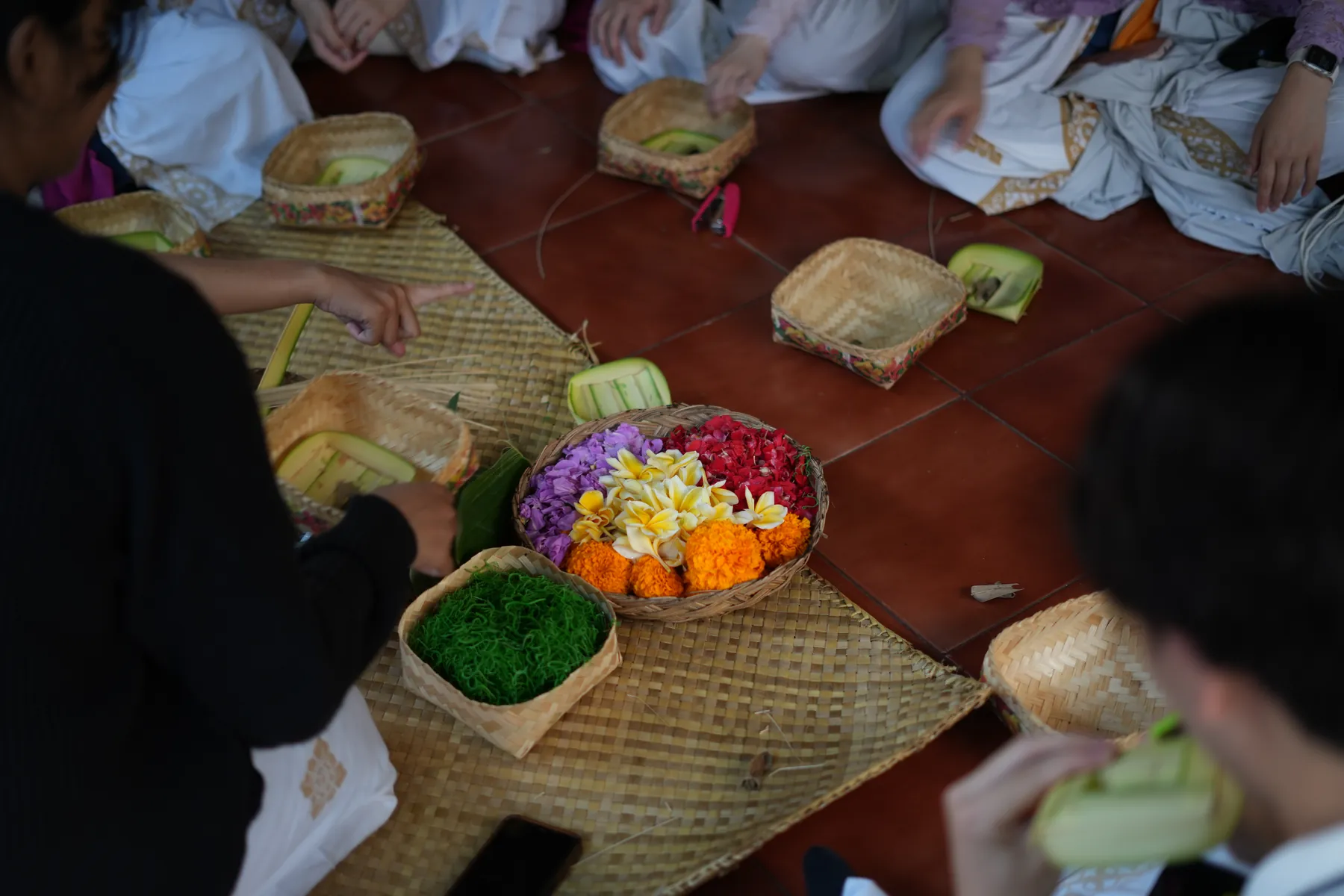
Many of our Curated Tours are based in Bedulu, a village a quarter of an hour from Ubud. There, Offerings of Bali: Create, Pray, Share is the hands-on way into the festival. You learn to make canang sari and a gebogan, the tall tower of fruit and cakes you’ll see carried to temples all week. Then you dress in Balinese ceremonial clothes, join a prayer and blessing at the family temple with holy water and bija, a few grains of rice placed on the forehead, and afterwards share the offerings with your hosts, a meal called ngelungsur. It takes two to three hours and runs by arrangement, so ask which days around Galungan suit the host family.
How to visit respectfully, and what to wear
Nobody expects visitors to know every custom, but these few go a long way:
- Dress for a temple whenever you’re near one. Cover your shoulders and knees, and wear a sarong with a sash tied at the waist. Bring your own; you’ll need it often this week.
- Stay in the outer courtyard unless you’re invited in. Bali’s rules for foreign visitors ask you not to enter the main area of a temple except to pray, in Balinese dress, and not while menstruating.
- Keep clear of the prayers. Never pass in front of someone who is praying. Walls, shrines and sacred trees are not viewpoints, however good the angle.
- Watch your step. Offerings sit on the ground at every gate and crossroads this week.
- Keep the camera down during prayers unless someone tells you it’s fine, and switch the flash off.
- Take a little of any food or drink you’re offered, and pass things with your right hand.
To understand the small palm-leaf trays you’ll see everywhere, read our guide to canang sari and how they’re made.
Questions travelers ask
When is Galungan 2027?
Twice: on Wednesday 13 January and Wednesday 11 August 2027. Kuningan follows ten days later each time, on Saturday 23 January and Saturday 21 August.
Should I plan my trip around Galungan?
Yes, if you’d like to see Bali at its most festive. The practical costs are small: busier roads on Penampahan and Galungan, a few closed warungs, and drivers who need booking ahead. Hotels and beaches aren’t affected.
Can tourists take part in Galungan?
Galungan prayers are family and village occasions, so as a visitor you watch from the edge unless you’re invited. To take part as a guest, book Offerings of Bali: a Bedulu family hosts you from the offering-making through to the blessing and the shared meal.