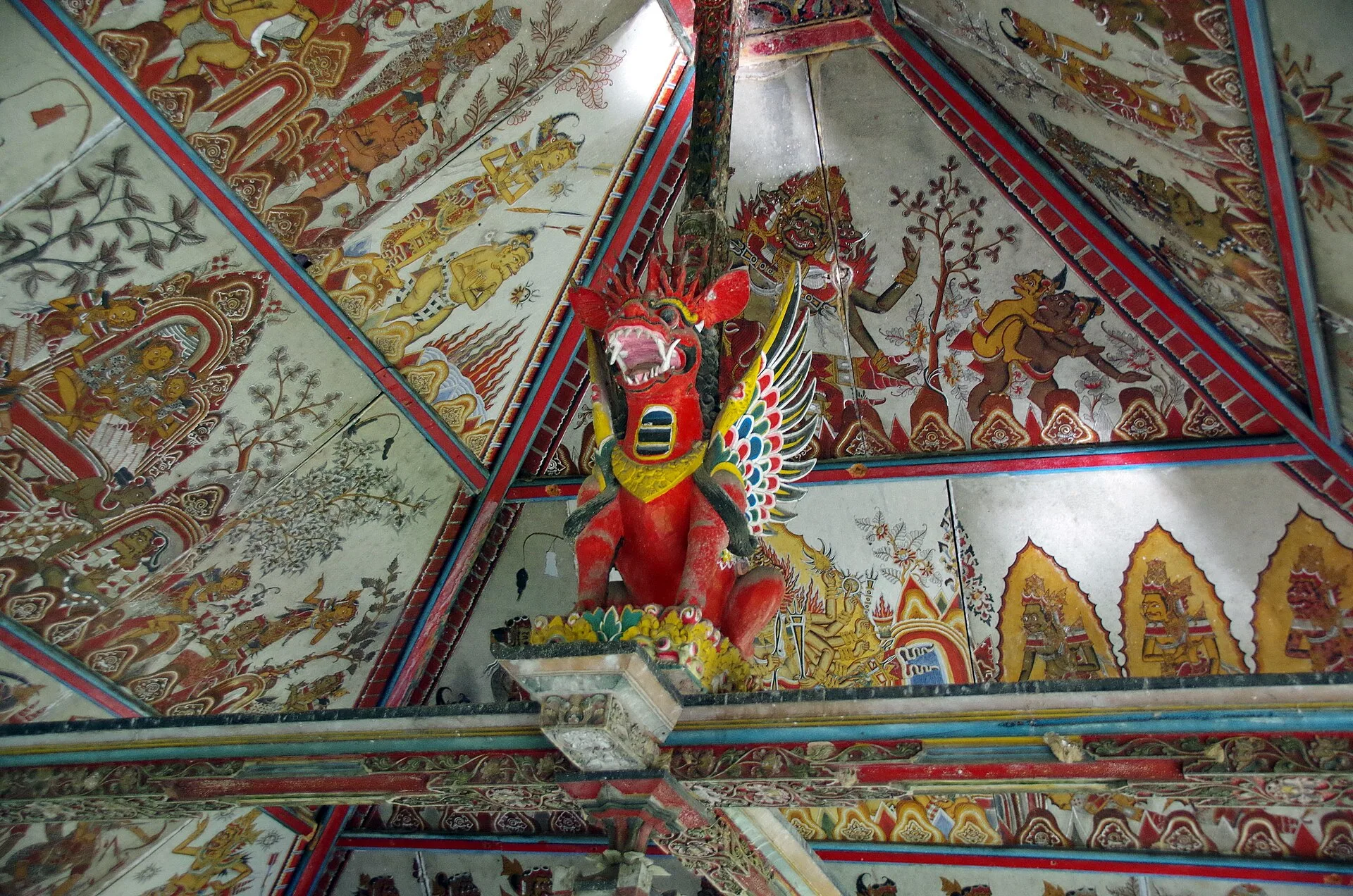
Bring binoculars to Kertagosa, or at least a phone with a decent zoom. The story you came to see is painted on a ceiling several meters above your head, in panels crowded with small figures, and it is easy to spend ten minutes squinting before giving up. With a little preparation, it becomes one of the most readable places in Bali.
Kertagosa stands in Semarapura, the capital of Klungkung regency in East Bali, and its ceiling is painted in the Kamasan style, named after a village just outside town where painters still work in the same tradition. This guide covers both: how to read the ceiling, and what you learn by picking up a brush in Kamasan.
A court, a kingdom and 1908
Klungkung’s royal house held the highest rank among Bali’s kings, and Kertagosa was part of its palace complex: an open pavilion where legal cases were heard and judged. Beside it, Bale Kambang, the floating pavilion, sits in a moat with a painted ceiling of its own.
The palace itself did not survive. In April 1908, as Dutch forces advanced on Klungkung, the king and his court walked out to meet them in a puputan, a ritual fight to the end, and many of them were killed. Most of the palace was destroyed; the pavilions and a gateway remain. A monument across the road marks the puputan, and it deserves a quiet minute before or after the ceiling.
How to read the Kertagosa ceiling
The paintings are in wayang style, drawn from the shadow puppet tradition: figures in profile or three-quarter view, faces and gestures fixed by character type, flat color held inside dark outlines. Once you know that a hero, a demon and a servant are each drawn in a set way, the crowd of figures starts to sort itself out.
The main story is Bima Swarga. Bima, one of the five Pandawa brothers of the Mahabharata, travels into the afterlife to free the souls of his parents, and passes through the places of punishment on the way. The lower tiers show those punishments in detail, each matched to a particular wrongdoing, and they are graphic, inventive and now and then darkly funny. Higher up, the scenes turn to reward and heaven. For people waiting under this roof for a verdict, the message was hard to miss.
What you see today is not the original paint. The panels were damaged in the early twentieth century and repainted by Kamasan artists, with further restoration later, so the ceiling is a living copy made within the same tradition rather than a relic.
What to look for
- Bima himself. In wayang convention he is drawn big and powerful, often with a long thumbnail and a black-and-white checked cloth.
- The lowest row first. Walk the pavilion slowly and follow the punishments all the way around before you look higher.
- Matched penalties. Each punishment is chosen to fit the offense. Guessing the crime from the penalty is half the fun.
- The change in mood. Toward the top, the scenes calm down as the story reaches heaven.
- Bale Kambang. Cross to the floating pavilion and look up again; its ceiling tells other stories.
Morning light helps, and the site is usually quieter before tour groups arrive from the south.
Kamasan, where the style still lives
Kamasan is a village a few minutes from Semarapura, and for centuries it supplied paintings to the Klungkung court and to temples across the island. Families still paint there, many of them working from studios in their own homes.
The traditional method is slow. Cotton cloth is sized with rice paste and polished smooth, outlines are drawn first, and color goes on in stages. The pigments were traditionally natural: soot for black, bone for white, ochre and earth for yellows and reds, indigo for blue. A large composition can take weeks. Some painters now use commercial paints alongside or instead of natural ones. Neither is wrong, but the price and the description should tell you which you are buying.
What the workshop is, and what it is not
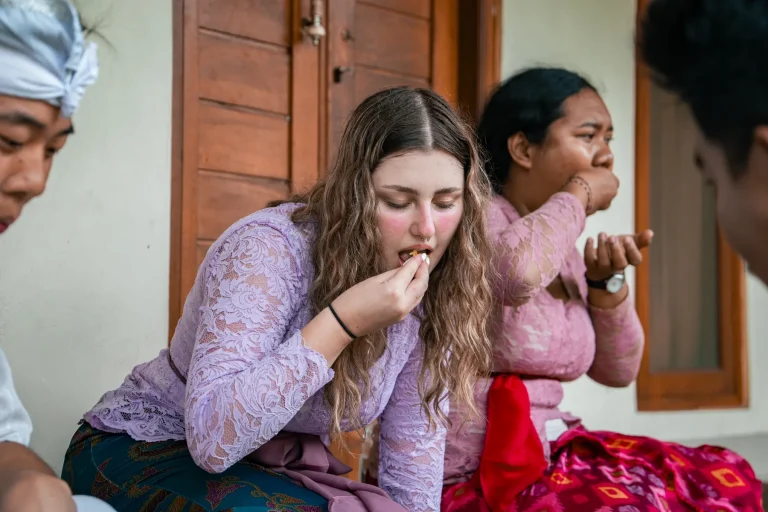
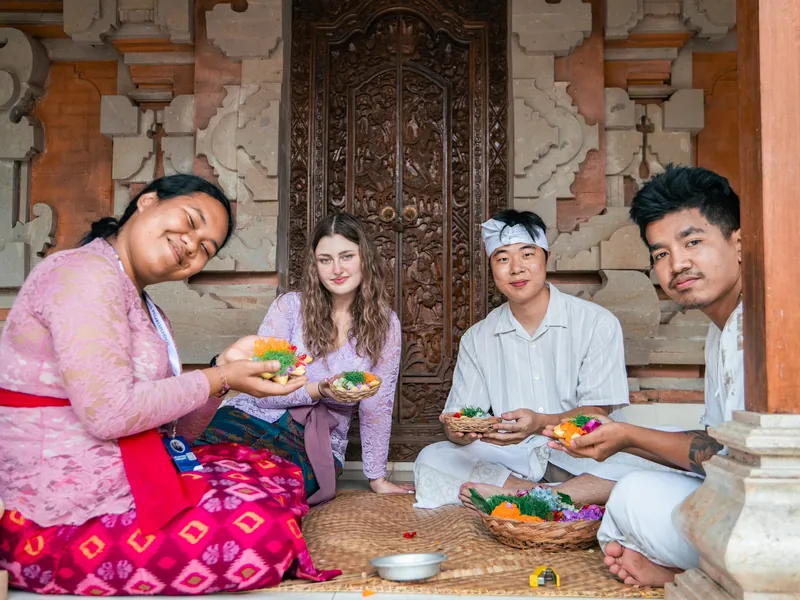
On the Klungkung journey, the Kamasan stop is a hands-on Balinese art workshop where you learn traditional motifs and create your own Balinese-inspired tote bag. It is a way into the style, and a good one: after trying to hold a steady outline yourself, the ceiling at Kertagosa looks very different. It is not an apprenticeship, and nobody expects a museum piece.
If you want to buy a painting while you are there, the principles in our ethical shopping guide apply: buy from the painter where you can, and ask about time and materials.
Two days in Klungkung
Day one follows the order of this article. After Kertagosa comes Klungkung Traditional Market, good for Balinese textiles, traditional motifs and a look at how local trade works, then a Balinese lunch, then Kamasan and the workshop before you check in to the hotel.
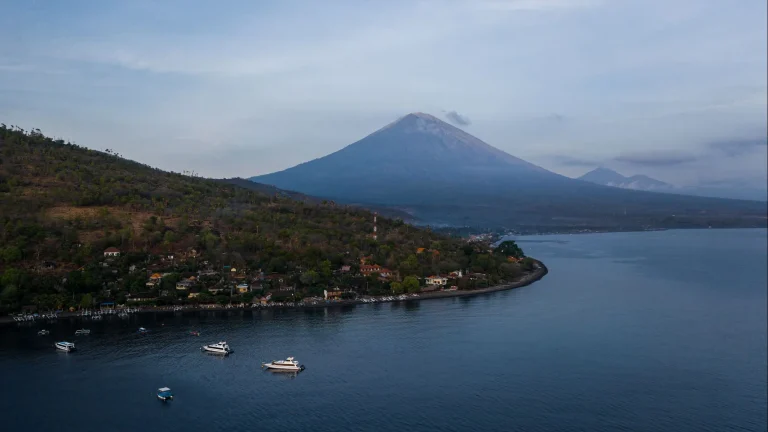
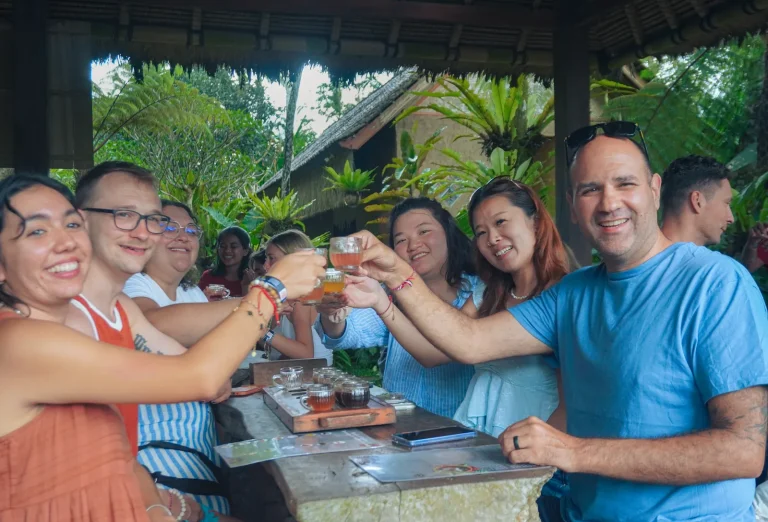
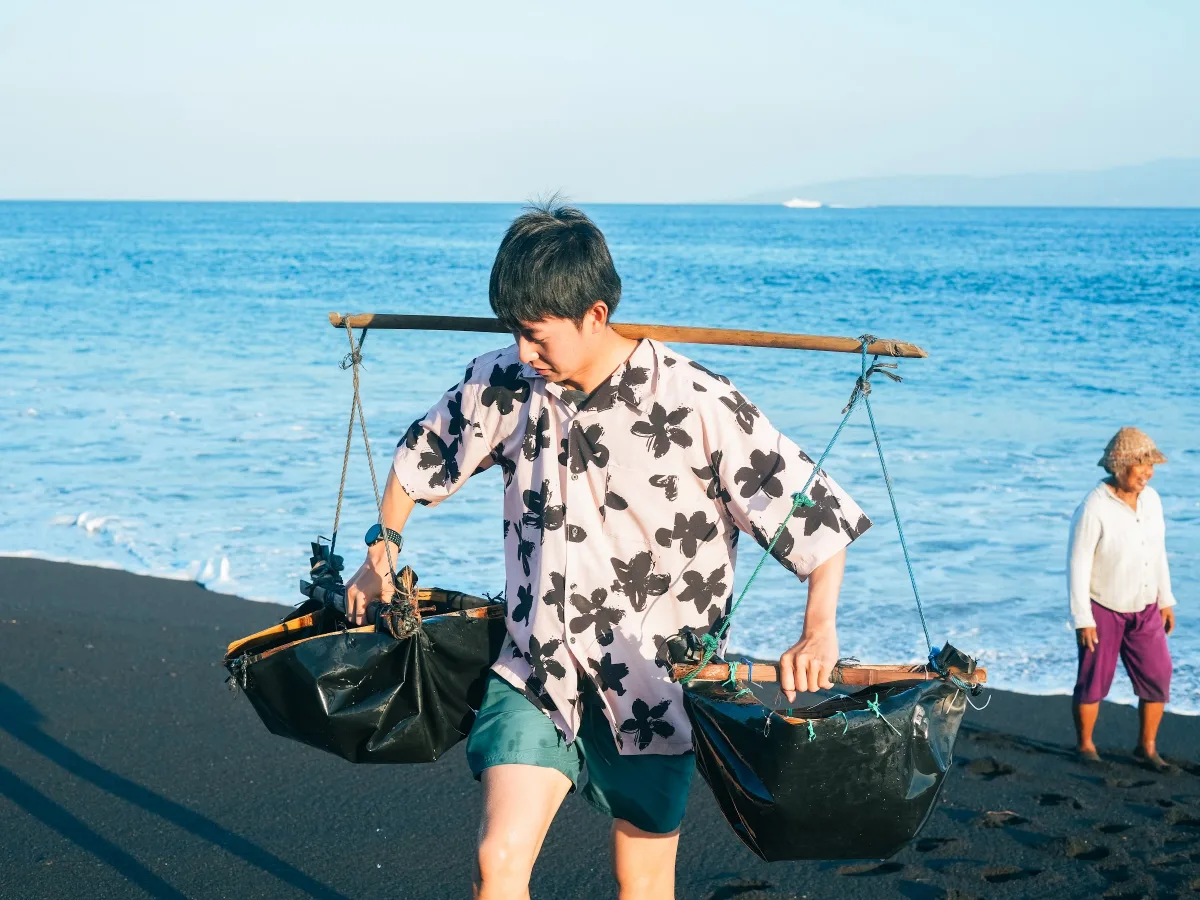
Day two leaves the palace behind for Nyegara Gunung, the Balinese idea that mountain and sea belong together. In Besan village you meet the community, including the village elder and the Forest Protector, prepare a personal plant offering, and walk through village life. You hike toward the sacred hill, visit Celuk Temple for a planting ritual, and pause for meditation at Tirta Mas Hill. After a local lunch the route drops toward the coast: a coconut sugar artisan, a traditional salt farmer, a fisherman’s boat out onto the sea, and a closing reflection back at the salt farm.
The journey includes private transport, an English and Indonesian speaking guide, activity fees and lunch on both days. A hotel room with breakfast can be added when you book. Pickup is from Ubud, Sanur, Seminyak, Canggu, Nusa Dua or Denpasar.

With more time, Sidemen is close by and makes a natural continuation: a cooking class, a temple blessing and a morning cycle that ends with the local weavers. Our two-day Sidemen guide lays out the valley in more detail.
Questions travelers ask
What should I wear to Kertagosa?
It is a historic site rather than an active temple, but modest clothing is expected. Covered shoulders and knees are a safe default, and a sarong in your bag never hurts.
How long do I need there?
About an hour for Kertagosa and Bale Kambang if you read the ceiling properly, longer if you add the small museum in the complex and the monument across the road.
Can I buy a Kamasan painting in the village?
Yes. Prices vary widely with size, detail and materials. Ask the painter how long the piece took and which pigments were used, and do not rush the choice.
Cover photo: Balou46 / Wikimedia Commons, CC BY-SA 4.0