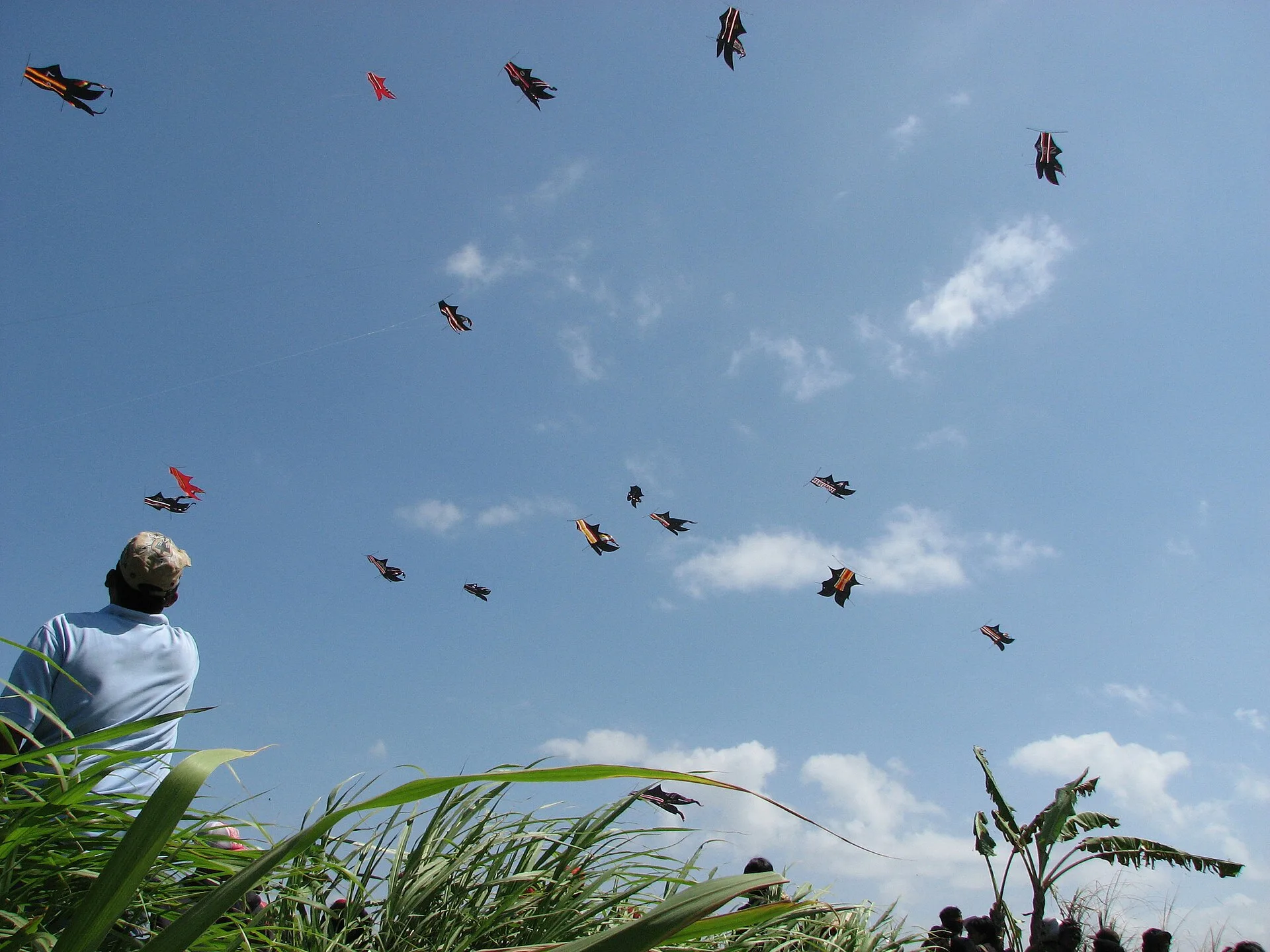
In July, look up almost anywhere in south Bali in the afternoon and you’ll see kites: small paper ones over the rice fields, torn plastic ones tangled in the power lines and, near the coast just north of Sanur, kites the size of a small boat trailing cloth tails long enough to cross a football field. Some carry a hummer that drones in the wind, so on a good day you hear the sky before you see it.
This is kite season. It peaks in July and August, and its biggest stage is the Bali Kite Festival at Padang Galak. Here’s what you’re looking at, why it happens now, and how to watch without ending up under a falling fish.
Why the sky fills up in July and August
The dry season brings steady winds from the east and south-east, strong enough to lift a kite that takes a dozen people to carry. Kite flying in Bali has long been tied to the farming year. Kites are flown as a way of giving thanks and asking for good harvests, and they’re linked to Rare Angon, the divine herd boy honored as the god of kites. That’s why the big ones receive offerings before they fly, and why a new janggan often gets a ceremony of its own. Children fly kites all over the island in the same weeks, from rice-field paths, empty lots and rooftops, so even far from the festival the season is hard to miss.
Three traditional kites to know
- Bebean: the fish. The name comes from be, the Balinese word for fish, and the shape has a broad mouth and a split tail. Usually the biggest of the three.
- Janggan: the one with the tail. It has a dragon’s head at the front and a long cloth tail that can run to 100 meters or more. Janggan are treated as sacred, and many are blessed before their first flight.
- Pecukan: leaf-shaped and hard to master. It’s unstable in the air and prone to tumbling, which makes a clean flight a real achievement.
Alongside these you’ll see newer designs, often entered as kreasi (creations), in whatever shape a team can dream up and then persuade to fly. Size is hard to grasp until you’re standing next to one: the frame of a big bebean can be several meters across, and it usually arrives on the back of a truck.
Kite flying as a village team sport
Big kites belong to banjar, the neighborhood associations at the core of Balinese village life, and building one is a group project: bamboo frames, many meters of cloth, weeks of evenings. On festival days teams carry their kites through the streets or truck them to the field, often with a baleganjur, a marching gamelan, playing alongside. Launching a bebean takes a crowd. Some hold the frame, some run the line, and one person calls the moment to let go. Bringing it down again is just as much work.
For visitors this has two side effects. The festival is as much about the teams as the kites, so watch the crews as well as the sky. And the roads around Sanur and eastern Denpasar can clog on festival days, with trucks and processions moving at walking pace.
The Bali Kite Festival at Padang Galak
The festival is usually held around July and August at Padang Galak, an open stretch of coast between Sanur and Kesiman in eastern Denpasar. Dates change every year and are often confirmed fairly late, partly because everything depends on the wind, so check local listings once you’re on the island. In some years kite competitions have also been held at Mertasari beach in southern Sanur. It’s a public, community event: you stand where the local crowd stands, and nobody is performing for tourists.

How to watch safely
- Never stand under a flying line or in the path a kite would take if it fell. Big kites do come down, and fast.
- Kite lines are strong and can cut skin when pulled taut. Keep your hands off lines that aren’t yours, and keep children close.
- Give launch teams room. The run before a launch needs clear ground.
- Check the wind before you pick a spot. A kite that breaks free drifts downwind, and so does a falling line.
- Arrive early for a spot, and leave before the end of the day or well after it, when everyone heads home at once.
- Bring a hat, water and sunscreen. The fields have little shade.
- Leave the drone at home. The sky is busy enough.
Two slow days on the same coast
Kite season is a good reason to base yourself in Sanur, and the Sanur journey is designed for an unhurried couple of days with no long drives. Day one starts with a mangrove walk and lunch at a mangrove garden, then an ecoprint pounding workshop with a local artisan, where leaves and flowers are hammered onto cloth to print their shapes, and a session making natural incense with a local maker. Day two opens with morning yoga, then a cycling tour of coastal Sanur with a local host, which in July can come with kites overhead. Only the yoga needs an early start, so the afternoons stay free for the kite field.
If you’d like the city side of the same stretch of coast, the Denpasar journey spends two days in Bali’s capital: a heritage walk along Jalan Gajah Mada with Kultara, taking in Pasar Badung, Pasar Kumbasari and Puri Pemecutan, then lunch and Museum Bali, an optional evening at the Pasar Kreneng night market, and next morning a melukat at Pura Kereban Langit followed by a local art space.
Questions travelers ask
Can visitors fly a kite too?
Yes. Small kites are sold at roadside stalls and markets during the season. Fly them in open fields away from roads and power lines, and well away from the airport, where kite flying near the flight paths is discouraged and in places banned.
When is the best time of day to watch?
Usually the afternoon, when the wind is strongest. Mornings are for rigging and setting up, which is worth seeing in its own right if you like to know how things work.
What else is happening in Bali in August?
Independence Day on 17 August brings village games and parades all over the island; our guide to 17 August in a Balinese village covers what to expect. For the rest of the dry season, see our guide to the best time to visit Bali.
Cover photo: Rarioj at English Wikipedia / Wikimedia Commons, Public domain